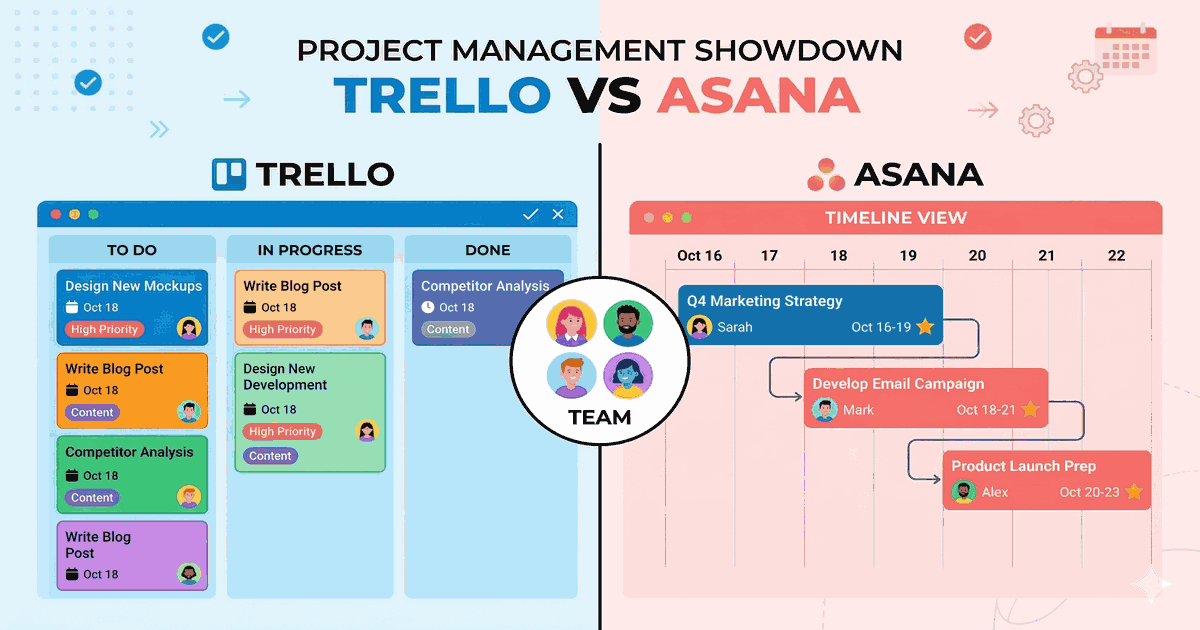
If you’re running a small team and need a project management tool, Trello and Asana are probably on your shortlist. Both have solid free plans and millions of users. But they’re built for different work styles. Here’s how to decide.
Quick Verdict
Choose Trello if your team thinks visually and wants the simplest possible Kanban board experience. Setup takes minutes, not hours.
Choose Asana if your team needs structured task management with multiple views, subtasks, and room to grow into more complex workflows.
For a full feature comparison, visit our Trello vs Asana comparison page.
Free Plan Face-Off
For small teams, the free plan often determines the winner. Here’s what you get:
| Feature | Trello Free | Asana Free |
|---|---|---|
| Users | Unlimited | Up to 10 |
| Projects/Boards | 10 boards | Unlimited projects |
| Views | Board only | List, Board, Calendar |
| Storage | 10MB/file | 100MB/file |
| Automations | 250/mo | None |
| Mobile app | ✅ | ✅ |
Trello’s advantage: Unlimited users and built-in automations on the free plan.
Asana’s advantage: More views, larger file uploads, and unlimited projects.
Ease of Use
Trello: Learn in 5 Minutes
Trello uses a simple metaphor: boards → lists → cards. Drag cards between lists to update status. That’s it. There’s almost zero learning curve, which makes it perfect for teams that include non-technical members.
The flip side: Trello’s simplicity means you’ll outgrow it quickly if your projects become complex. Adding due dates, labels, and checklists helps, but it’s still fundamentally a Kanban board.
Asana: Learn in an Hour
Asana requires more initial setup — you’ll need to decide on project structures, task hierarchies, and views. But once configured, it handles complex workflows that Trello simply can’t.
Subtasks, dependencies, custom fields, and sections give you the structure needed for real project management beyond basic task tracking.
Winner: Trello for instant simplicity. Asana for structured power.
Features That Matter for Small Teams
Task Management
- Trello: Cards with checklists, due dates, labels, attachments. Simple but effective.
- Asana: Tasks with subtasks, dependencies, custom fields, assignees, and due dates. More structured.
Collaboration
- Trello: Comments on cards, @mentions, activity feeds. Straightforward.
- Asana: Comments, @mentions, status updates, and project conversations. More communication options.
Automations
Surprisingly, Trello wins here on the free plan. Butler automation is included free (250 runs/month), letting you automate card movements, notifications, and recurring tasks.
Asana locks automations behind paid plans (starting at $10.99/user/mo).
Reporting
- Trello: Minimal. You can see board activity and card counts, but there’s no real reporting.
- Asana: Basic dashboards and status charts available even on free plans. More data-driven.
Real-World Use Cases
When Trello Wins
- Content calendar: Create lists for “Ideas,” “In Progress,” “Review,” “Published”
- Simple sprints: Move tasks across “To Do,” “Doing,” “Done”
- Client projects: Share a board with clients for visual progress updates
- Personal productivity: Quick personal Kanban for daily tasks
When Asana Wins
- Product development: Track features with subtasks, dependencies, and milestones
- Team workflows: Assign tasks across team members with clear ownership
- Goal tracking: Set project goals and track progress over time
- Cross-functional projects: Manage work across marketing, engineering, and design
Scaling Considerations
Small teams grow. Here’s how each tool handles that:
| Factor | Trello | Asana |
|---|---|---|
| Upgrade trigger | Need more boards or views | Need timeline, goals, or custom fields |
| First paid plan | $5/user/mo (Standard) | $10.99/user/mo (Starter) |
| Team of 5 cost | $25/mo | $54.95/mo |
| Team of 10 cost | $50/mo | $109.90/mo |
| Enterprise features | Limited | Comprehensive |
Trello stays cheaper at every team size, but Asana offers more sophisticated features at each tier.
The Bottom Line
For most small teams, the choice is clear:
- Just need a visual task board? → Trello. It’s simpler, cheaper, and has free automations.
- Need real project management? → Asana. More views, better structure, room to grow.
Start with Trello if you’re not sure — it’s the lower-risk choice. You can always migrate to Asana later when your needs grow. (Asana even has a Trello import tool.)
Want to see other options? Check out ClickUp (which combines the best of both) or browse the best free project management tools.